Phenomenal . . .

Phenomenal . . .
Life, Growth, and Connection (This sunflower was nourished by my hands.) 2010; Photography by Benita Blocker. Please become a follower of this blog.

Total Pageviews

Showing posts with label touchup. Show all posts

Sunday, February 12, 2017

Some Professional Black Women Prefer Relaxers in 2017

Vitale Pro High Comfort Regular Relaxer service by Benita Blocker.

Paul Mitchell Regular Relaxer Service by Benita Blocker.


Fiberguard Affirm Mild relaxer service by Benita Blocker.

All Black women are NOT going natural.  More than half of my clientele receive relaxer services.  If it is not broke, why try to fix it?  For the Black women who love their natural hair and have discovered a routine, more power to you. For those who are ready to give up, my business was built on chemicals.  The "creamy crack" has been around for as long as the "pressing comb" - you can have healthy, long, relaxed hair.  

The most frequent relaxer touch-up service is at a 7 week period.  Some clients get a virgin relaxer once a year. Relaxers are more weather resistant.  Overall, they save my clients time and money.

Monday, June 27, 2016

Revolutionary Relaxer Service News 2016


Relaxer Touch-up tips for Growing Long, Relaxed Hair:

  • Blot the hair dry 
  • Lift the client's head completely up from the shampoo bowl
  • Visually, check the nape and hairline areas for relaxer residue
  • Check neck of the shampoo bowl for relaxer residue
  • Use a color indicator solution to take the guesswork out of alkalinity
  • Check the neck towel for signs of alkalinity
  • Shampoo several times if needed
  • Never condition before shampooing when neutralizing
  • NOTE:  Squeaky clean hair does not mean the relaxer residue is completely washed away.
  • Make sure multiple shampooing does not dry out the hair.  
  • Use conditioning neutralizing solutions. (Two products are mentioned in this youTube video.)
This video shows akaline water tests.  Porous hair should have as much water removed as possible before the final neutralizing shampoo is completed.


Thursday, May 3, 2012

Protective Styling Blues

Like all good things . . . eventually it has to come to an end. I have really been enjoying the ease of keeping my hair clean, moisturized and plaited. I am getting a good size afro at the roots with the relaxed ends holding the plaits together. I have a little arsenal of new wigs to change in and out of and was anticipating relaxing my hair again in July or August 2012.

However, I have had one too many people to ask me "how my hair is doing?" Then on top of that one of my clients hugged me and cupped the back of my head/hair. I did not say anything to her, but I was rather irritated! I am one "sista" that does not like anyone touching my hair unless I expect you to touch my hair - wig or no wig.

But with that said, I had been wanting to try Affirm's Control/Time Release relaxer. My distributor apparently does not carry that one on a regular basis so I will have to see if they can get me a fresh batch; if not, I may relax the front half of my head with the Paul Mitchell Super and continue protective styling the back until I get all of my back hair passed my "solid" three inch goal. Any hair under three inches gets overprocessed too quickly and past due touch-ups are very noticeable when the hair is under 12 inches long.

So I am at the crossroads, either succumb to society pressure or stay on course with my goal. I have been wearing protective styling for about four months. Another three more months would be ideal. Stay tuned.

Monday, January 2, 2012

Relaxer application: Pre-protect or not?


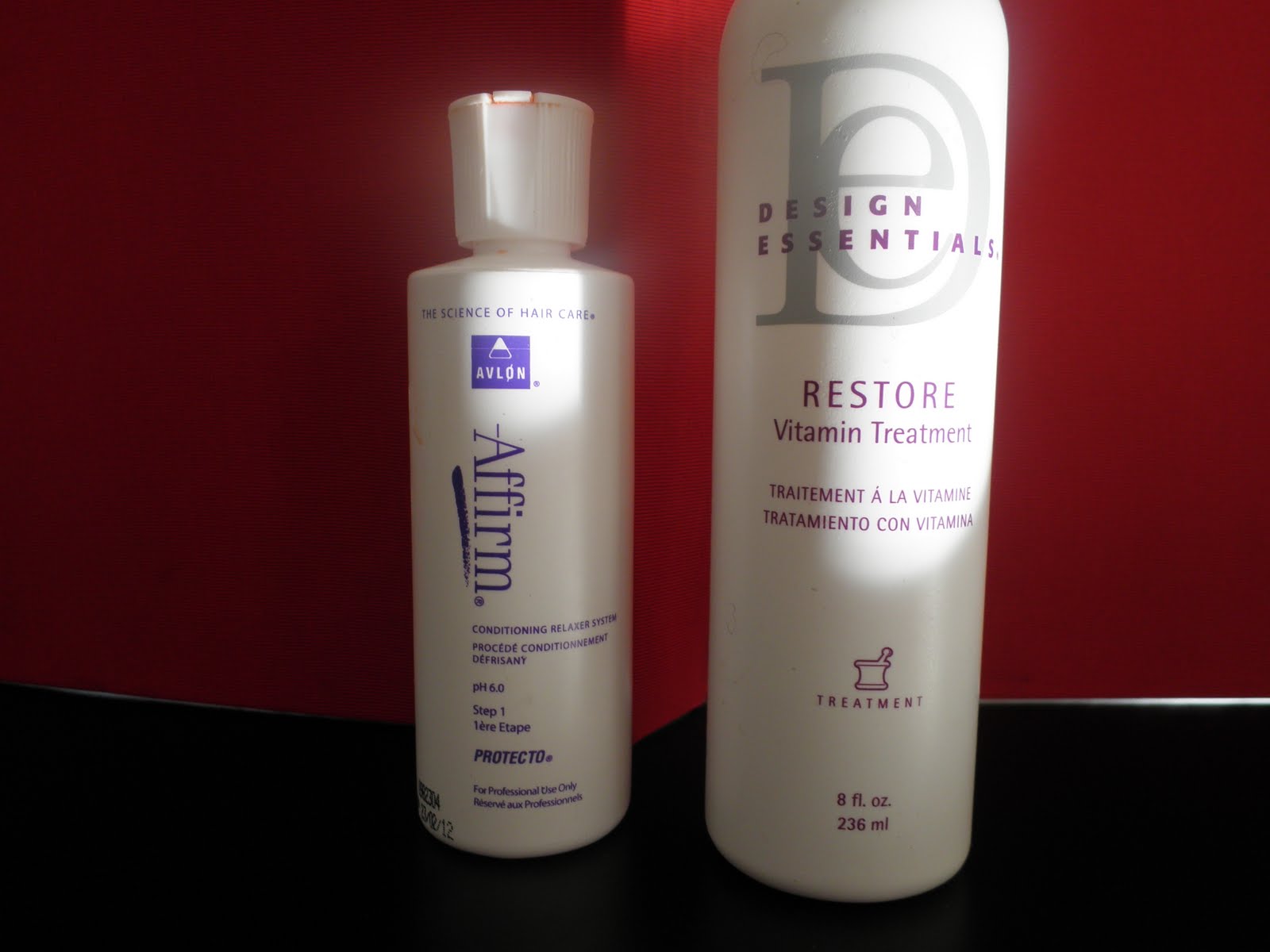
Most Relaxer systems have a "pre-protect" lotion to apply to the previously relaxed ends of the hair strands. Pictured here are the "Protecto" by Affirm and the "Restore" by Design Essentials. Fiberguard Affirm has a "Preservo" pre-protect lotion.

Almost all of the pre-protect lotion/creams are "wet" to the feel. They are designed to fill in the hair shaft, even out porosity, and protect the ends from any relaxer getting in the wrong place. According to the educators in the relaxer classes, this is a necessary step. However, after review of a few youtube videos and playing back in my memory banks a few distinguished classroom settings on relaxer application, I now question if the "pre-protect" step slows the relaxer application time down for some hair types. (i.e. slows the stylist's speed down during the relaxer application step)

Sometimes the hair ends start to stick together after applying the pre-protect lotion. The hair wet by the pre-protect lotion can be harder to part; therefore slowing the stylist application time down/slowing her speed down. However, I know the educators are their to help sell all components of the product line.

According to one youtube video:

http://www.youtube.com/watch?feature=endscreen&v=aCXnMxKNJlY&NR=1
She recommended "two minutes application time" per quadrant. (being four quadrants) The stylist based the scalp, but she did NOT use any pre-protect lotion. The model's hair seemed to be easy to part through. The hair ends did not stick together. I going to assume the model was a type 3 curl pattern. Nonetheless, the relaxer application seemed to be "on point."

I will also say that in part 2 of this particular stylist video instruction which I am not going to attach to this blog, I did NOT agree with blowdry, flat iron, and haircut of the second portion of the video. I felt the blowdry was too aggressive since she was focussed on avoiding uneven processing. I also felt that a roller set would have been more appropriate than flat ironing. This is just my opinion.

Sometimes you have to absorb what you need to know and let the other things that are not applicable to you "go out the other ear."

This article is food for thought. If the client has detangled, manageable hair, then I suggest not to wet it down with "pre-protect" lotion, but DO not be sloppy with your new growth application. This should increase the hairstylist's relaxer application speed. Goal: 2 minutes per quadrant avoiding getting too much product on the scalp.

Also, everyone should keep their ends trimmed to avoid split ends and to avoid the hair ends catching on themselves.

Tuesday, October 4, 2011

Relaxers: Alternating between Mild and Regular?

Please don't call the relaxer police! Yes, I did it again . . . 3 weeks 6 days later . . . I relaxed my hair again.


However, I used the Mild strength of the True Indulgence relaxer. As you can see from the pictures, it did not straighten my hair as well as the regular strength did. However, my new growth at about 4 weeks was giving me a "fit." I had a mini-afro underneath the already relaxed hair. You can get away with a mini-afro if you have really long hair, but it is harder to camouflage when sporting a shorter haircut. As you can see from my picture at the end of this article, I did not lose much hair. This was all the hair in the bowl after completing the whole relaxer service. For some people, the amount of hair pictured in my hand is equivalent to a normal non-chemical shampoo. So it was a very safe relaxer service. I fear that I will have to relax again within another four weeks. I will have to decide if I want to use mild strength every four weeks until I get a solid three inches of hair in the back, then go to regular strength every 7 weeks? Or do I want to try alternating between mild and regular strength every four weeks? I am thinking the regular strength will correct the mild strength plus give me a little straighter roots. Since I used the regular strength True Indulgence relaxer about four weeks ago and still needed a touch up four weeks later . . . I really will have to see if this mild strength will get me to the four weeks mark before I can decide on a relaxer touchup regimen that works for me.

With that said, remember every one's hair is different. I have more coarse, resistant, type 4c hair. So "what works for me" may be "overkill" for a fine, type 4c hair.

Also, I noticed a number of bloggers and youtube videographers who were very focussed on achieving "bra strap length (BSL)" or "armpit length (APL)." However, if they continue using ceramic flat irons, then they may get there, but it will eventually break back off. They will forever battle maintaining their length. I have seen it time and time again. (i.e. the reason that neither my clients nor I use flat irons in my salon.) The flat irons are not a friend to "long, curly hair." I have quite a few recent articles including the flat iron free pledge. Also, if you take the flat iron free pledge, then you can NOT cheat! No more flat irons at all . . . if 200 to 300 degrees will not straighten your hair, then 400 degrees may straighten; yet, you will be causing internal damage. Internal damage will come back to bite you one day with continued abuse.

While on the topic of length, I am also focussed on long term length for my own hair. However, for the short term, I am keeping the back trimmed. That Chi Deep Brilliance Super strength relaxer really fried/dried some my ends out. I think that I have about trimmed away the last of them. I know a few of the new followers are probably thinking why did you use a super strength relaxer anyway? Well, I used the super strength in the Paul Mitchell relaxer system quite regularly and loved it. It was not strong enough to hold my hair straight so I had concluded that the "White/mainstream" super relaxers are not as strong as the "Black/ethnic" super relaxers. Oh boy, the Chi/Farouk Super strength relaxer proved that theory WRONG. That relaxer was absolutely ridiculously drying to my hair and it did not even straighten it all the way. I even got a chemical burn down my neck from the runoff. I am going to assume that I got a defected batch of this Super strength, but Lord knows -- it is off my list of ever trying again. Also, I noticed the "Vietnamese beauty supply" stores are selling the very same relaxer to regular people without a cosmetology license. Please see my article on "Hair Battle Wounds" if you want to live through that relaxer experience.

One last topic: Determining when it is time for a relaxer touchup? If you are tempted to use the curling iron everyday because your new growth is showing, then it is time for a relaxer touchup. Everyday heat from a curling iron is going to still cause damage. Luckily, you will see the damage more immediately than if you are flat ironing it. Damage is still damage. Whether you see it sooner or later, damage is what you are trying to avoid. With that said, box relaxers are a "no no." Any relaxer that you have to mix is a "no no." The safest relaxers are sodium hydroxide based relaxers. Some of the lithium hydroxide relaxers are "no mix." However, I think that the lithium hydroxide relaxers leave buildup in the hair similar to the "box" relaxers which are usually calcium hydroxide based.

Hopefully, I have tackled all angles on choosing relaxer touchup over excessive curling iron use. Also, this article serves as a review on the mild strength True Indulgence relaxer. My clients and I are still very, very pleased with the True Indulgence relaxer. I had a client yesterday mentioned how her daily maintenance has been so much easier with this relaxer. I was happy. For me, my search is over. I really like the True Indulgence relaxer system. Stay tuned. I will keep you posted on how long this mild strength touchup lasts . . .

Sunday, October 25, 2009

Bodiphier Touchup and Alkalinity discussion

I completed my Bodiphier touchup this week. I have to admit that I had two shampoo services within about three days of the Bodiphier touch-up. I gave my scalp one full day of rest before performing the touch-up.

To my surprise, I did experience a tingling/burning with the touch-up. I remember the water during the rinse prickling my scalp in some areas. So I did burn. However, I did not scab up.

I talked to the founder about my experience. He assured me that there was not sodium hydroxide present, but the alkalinity of the relaxer as a whole could cause burning in sensitive scalp clients.

I have an extremely sensitive scalp. I can not take a regular lye relaxer past five minutes. So I was a good test person for the Bodiphier's ability to burn.

I am still content with the Bodiphier relaxer. I just know that I need to give my scalp the traditional three day wait after shampooing before I touch-up again.

My main reason for all the shampooing was because I was going back and forth between the "wash and wear" styling and the pressing. I wanted it to be pressed and free of any styling products in order to complete the touchup.

I still have some straighter ends from the initial Soft and Beautiful Texturizer. I will eventually cut them off but not yet. Smile.

Overall, the Bodiphier is still the best option for going back and forth from straight to curly.

Tuesday, October 20, 2009

Bodiphier Relaxer Touchups

Hey! I am still enjoying the Bodiphier natural relaxer. I have quite a few clients in the product now, and they are enjoying it!

After enjoying the benefits of the Bodiphier myself for so many weeks (six weeks so far), I almost forgot about the additional touchups that are needed. The new growth still needs to have a regular touch-up schedule if you are wearing the Bodiphier in a thermally straight capacity.

If you are "wash and wear" then you can push the touch-up out as long as you want. However, if you are pressing your hair out, the new growth reverts much quicker with the humidity as to be expected; and you can be prone to popping the hair off just like any other relaxed hair in need of a touch-up.

So if you are pressing; please keep your Bodiphier touch-up at regularly scheduled intervals. About every five weeks would be safe. My touch-up is scheduled SOON! My new growth is in full force. I can only tell when I pressed it out on Sunday and my roots stayed straight for about a day.

Is this process more expensive to keep up than the traditional relaxer? Yes, it is. But remember, you can "wash n wear" at anytime so you have the choice of TWO Looks after every shampoo! Either press it Straight or crunch it curly!