Phenomenal . . .

Phenomenal . . .
Life, Growth, and Connection (This sunflower was nourished by my hands.) 2010; Photography by Benita Blocker. Please become a follower of this blog.

Total Pageviews

Showing posts with label relaxer touch-up time. Show all posts

Tuesday, August 12, 2014

Back to School Hair Quiz for 2014


Questions:
1) Is it okay to get your relaxer touch-up if you are having your menstrual cycle or period?
2) Should you only get your ends trimmed around relaxer touch-up time?
3)  How can you tell if a permanent haircolor is going to turn out the right color?
4) Should a salon stick with only one product line?
5) How can you save money on your next braiding service?
6) Which hair blog just reached over 500,000 pageviews? (Hint:  This question is the easy one! )

Answers:
1) NO!  Don't do it! If your menstrual cycle is on, then your body's pH and hormones may cause your hair to be more resistant.  You may risk underprocessing the hair if the relaxer does not work properly. Days 1 through 3 of your menstrual cycle - definitely, skip the chemical processing. If you are on the tail end of your cycle, then it should not hinder the relaxer from properly processing.

2) If you have type 3 curl pattern or non-resistant hair, then you can trim whenever you want because you do not have to worry about a lot of shrinkage.  If your hair has 75% shrinkage and/or it is resistant, then you need to wait for the relaxer touch-up to cut when all of your hair is straight.

There are some people who get haircuts based on the moon and the Farmer's Almanac.  You will have do your own research on that cultural practice.

3) Use a popsicle stick from the craft store to stir up the color.  Watch it develop on the popsicle stick to get a ballpark idea of the final color. Permanent haircolor should not have any darkness when initially coming from out of the tube or canister.  It should only darken after mixed and has been sitting for some minutes.

4)  The last Design Essentials platform artist suggested one product line for the whole salon.  However, she also mentioned that she cocktailed some of the products together to create solutions as needed.  I do not agree with this practice.  Why assume that all hairstylists are great chemists?  If another product line has a superior conditioner or a superior styling aid, then I want the best for my clients. Most product lines have just ONE product that is their "best seller."  I like knowing the "best seller" items for every product line.  I also like having a backup plan in case a manufacturer is on back order for a product.  Many of the Black haircare companies have had a shortage on product availability for too long, and we as hairstylist are forced to find an alternative product that works.  Sometimes I return back to the original product  and sometimes I find that I want to stick with the new replacement product from a different line.

5) Try Redheart yarn!  It burns like the jumbo braid hair.  You can use it for yarn braids, havana twists, and kinky twists.  There are some youtube videos for using the Redheart yarn for twists. Typically, you need several strands of yarn at a time for thickness, but the skeins cost between $2.00 and $5.00 USD.  If you buy 7 packs of jumbo braids, then you will spend over $20.00 USD.  However, one large skein of yarn at $5.00 USD may be all your braider needs. So you save OVER $15.00 by using yarn.

 You can also put rods around this yarn and dip into hot water for curls just like the regular braiding hair.

The yarn maintains its original yarn color.  When it is heated, it does temporarily change colors, but as it cools down, the original yarn color re-appears. Walmart stores sell Redheart brand of yarn.

6) Yes, this blog www.phenomenalhair.blogspot.com just reached over 500,000 pageviews.  The blog is five years old, and I am so proud of our progress! Thank you for helping to make this milestone possible.

Hopefully, you passed this quiz! You needed to get at least 4 answers out of 6 correct! Still have questions? Then please let me know!

Tuesday, November 6, 2012

Three colors safe to use on relaxer day

Resistant Gray or White hair? No problem.  These Sebastian Cellophanes semi-permanent colors (Deep Brunette, Shine Clear, and Golden Brunette) require no mixing.  The "Deep Brunette" delivers "black, darkest brown."  The "Golden Brunette" delivers "caramel."  The "Shine Clear" can be used alone to seal the hair after conditioning or it can be used to dilute the other two colors.

The best deal about the "Deep Brunette" is that all three primary colors are already blended into this color so it makes resistant gray no problem with coverage.  Resistant gray hair should process at least 25 minutes to 30 minutes with a cool down in order to ensure coverage.  This color does has to be shampooed to remove excess from off the scalp followed by another instant conditioner if hair feels like it needs it.

Pictured is the newest Sebastian Cellophanes packaging.

Monday, May 14, 2012

Texture Talk: SisterLocks Consideration

I decided NOT to perform a relaxer touch-up, but I want to give people what they want to know: So how is my hair doing? LOL! So I am pouring it all out in this article.

First of all, most hairstylists do NOT have my kinky, wiry type of hair. So they typically do not know how to handle this type of hair. Can you see my line of demarcation? My last relaxer touch-up was about five months ago. You can see the thicker density of hair at the roots and about two inches out. Then it is thinner density where the relaxed hair starts. (I have another picture later to explain this better.) Also, I actually think that the front quadrant of my hair is type 4b, the back above my occupital bone is type 4c, and my nape area below my occiptial bone is a type 4a. Three different textures, but back to my initial point . . .

So secondly, I have purchased a "cruise ship" worth of products over twenty years without regard to price, and I am convinced that the 2 million product lines on the market have no idea how to work with my type of hair. I literally have to eat a meal and do body stretches before I start to tackle my hair. When "sistas" feel that they want to just "cut it all off" - I know exactly how they feel. (and I am an active licensed cosmetologist in three states and feel the exact same way.) Unfortunately, my huge forehead and fat jaws are not going to pull off a "crew cut." Also, the products on the market are still not for kinky, wiry hair.
My sideview: So almost an hour later, I have my hair flat twisted. Those relaxed ends gave me "hell." I did not condition because the shampoo seemed to soften and detangle enough. I shampooed with Bee Mine Botanical Moisturizing Shampoo as my final shampoo. I had to use Paul Mitchel Shampoo one and KeraCare First Lather Sulfate-free shampoos initially to get all the extra hairdressing washed out. Then I used Design Essentials Defining Creme Gel to twist. These twists are still wet. The texture between the new growth and the relaxed hair looks about the same. Now, I have to sit under the dryer for at least another hour . . .
My Backview. I have not captured the backview in awhile. Remember, my hair is wet in this picture. I still have to go under the dryer.
Okay, look closely here! My flat twists are now dry. Can you see the new growth clearer now? Honestly, the relaxed ends are still the core hair that is still twisted. The relaxed hair did NOT want to dry. Because there is such a big difference between my relaxed hair and my new growth, I really need two different setting agents. The Creme gel really is too heavy to dry my relaxed hair, and if I used a lighterweight product, then it would not be heavy enough for my new growth. Remember I mentioned "SisterLocks" in my subject? Well, SisterLocks do NOT require you to cut off your relaxed hair. They can start sisterlocking one and a half inches at the roots and leave the relaxed hair alone. So my protective styling has got me to another milestone to do something different. Yay!!!
So about three hours later, my finished style with transitional hair. Way too much work . . . way too much time . . . and I had to make it into this style. So why not relax it? I have been really meditating on this. I have had quite a few setbacks in my life: Ionic Flat irons -HUGE SETBACK! Permanent haircolor - my type of hair does not need two permanent chemicals in it! Relaxing too often - I have seen too much scalp damage out there! So for those of us who can not get a comb through our hair at the five week mark - what do you do? Okay, those with "finer" strands but same curl pattern will find that mild relaxers will straighten their hair to their content. However, medium to coarse hair need a stronger strength to straighten the hair strand, but stronger relaxer strengths are NOT good for the scalp. So people say do not put in on the scalp. With curl patterns that coil back on itself, the scalp is going to get relaxer on it. For those whose hair grows away from the scalp, thank your Higher power. Your hair is easier to part and to comb through.
So as you can see another backview, you can not see my scalp- right? Well, I will say that I am not looking forward to sisterlocks because I will be forever tied to a SisterLock technician. However, I am over 40 years old now, and I really feel that relaxers and my scalp have come to the crossroads. I can not continue to subject my scalp to damage then wait for it to recover. One day it is not going to recover. I have seen enough pictures and images in my head to know the future if I continue in my same path.

In the days of Madame C J Walker, the beauty industry was offering the "hair growers" showcasing fair-skinned Black women. Our kinky head sisters were afraid of those "relaxers" back then and that is why the "press and curl" and the "Walker hair cosmetics" were embraced. The art of press and curl is getting lost. The pressing combs are made differently now. Even the high end pressing combs by Kizure and Golden Supreme all are made differently. Please see my other articles on pressing combs. I would consider going to a press and curl, but my natural hair is resistant to heat straightening, and I do not want it burnt out. It has been about twenty years since I met a hairstylist that knew the art of press and curling without the heaviness and the right amount of heat to temporary straighten the hair without damaging it. I do not remember her name, but she was close to the Clemson, Easley, South Carolina area. After 20 years, who knows where she is now.

So in conclusion, I desire to keep a European professional look for the corporate setting. So I want a straighter look without a relaxer, the Sisterlocks are smaller than dreadlocks. I have seen a lot of pictures of SisterLocks. Please note that sisters with slightly looser textures get sisterlocks and they look absolutely fabulous. For those of us with kinky, wiry textures, our Sisterlocks may have a little more frizz as they mature, but you still will have more freedom of style without the chemicals. Also, sisterlocks do not require any pomades. They use a tool to lock the hair.

Well, you may ask whether or not, I will become a Sisterlock technician? I do not plan to. I really feel like most women in the Carolinas do not want to pay for the SisterLock service. The initial investment is steep and time consuming and if you are starting your hair over, it will be short in length.

Most women will rather pay $500 on a few long sew-ins weave services before they spend that much money for a short, kinky hairdo. Patience is key. It takes two years to start enjoying the length of sisterlocks, but at least you can keep your relaxed ends while the roots are growing out. They will look like invisible braids, but it will be your own hair.

I will keep your posted. For now, I am going to continue playing around with my wigs until I find a certified Sisterlock technician that is not going to kill my tenderhead!

Sunday, February 19, 2012

Curl Pattern Theory by Benita Blocker


After working with so many different hair textures and curl patterns and scalps, I have been trying to figure out how to simplify how to deal with hair. Yeah, I am going deep with this article. It is all just my theory from my brain. I did not read what I am about to say anywhere. It is just my conclusions based on my observations from my practice, but here it is . . .
Pictured is curling ribbon. I purposely cut each piece to be equal in length.

Next picture: I ran a pair of scissors down one of the pieces of ribbon repeatedly. Probably about four or five times. Each time I ran that scissor edge down that ribbon, the ribbon got curlier and curlier. As you can see the same length ribbon shrink about 75% in length? Hard to believe that both pieces of ribbon are the same length. Right? Doesn't look like the same length when one ribbon is curled all up. Right?

So you are probably guessing how this ribbon is relative to a hair strand. Well, you are looking at Type 1 straight hair to a Type 4 kinky, extremely curly hair in the form of a ribbon.

My theory is that as the hair grows out of the scalp, some of our hair follicle roots are closer to the surface of the scalp, and as they come out the edge of the follicle is acting like a scissor blade causing it to curl as it grows out.

For those with follicles farther away from the scalp surface, the hair emerges less curly and more straight.

Those whose roots are closer to the scalp (i.e. kinky curly) are probably more sensitive to relaxers. Burning can come very quickly. Scalp damage and thinning from the relaxers can also be more likely because the scalp is being exposed to relaxer touchups more often per year than someone with less kinky curly hair. Plus the root of the follicle is closer to the scalp surface making the root more vulnerable to intense damage from the relaxers.

If the hair strand is coarse and kinky curly then stronger relaxer strengths are being used to soften the strand and smooth it out. The scalp exposure is greater because the roots are curling immediately out of the scalp.

Looser curl patterns grow away from the scalp with a wave or sometimes little kinky curly, but it does not curl back on itself.

Hair that curls back on itself is usually considered a z pattern or a 4c curl pattern.

Over the decades, I really do not think that the relaxer manufacturers have had this curl pattern in mind. With recent trends of women going naturally, kinky curly, they have been forced to recognize the intensity of curl patterns that exist out there. With this said, I wished they would make more relaxer instructional videos showing speed relaxer touch-up service on ultra- kinky hair.

Some stylists prefer using the rattail comb for relaxer touchup application for kinky curly hair. I had not picked up this habit because I thought that it looked a little "ghetto." However, I may have to really re-examine whether the rattail comb can give more control and speed for those with curlier textures.

In the meantime, I still love using the sprushes.

I know that this article is very scary and discouraging, but sometimes the truth is not always pretty. I am saddened by this article because I prefer to give you a solution with any potential problem. Unfortunately, I do not have any easy answers.

Am I saying that sisters with kinky-curly hair need to discontinue relaxers if they want to keep their hair on their head? I do not know. What I do know is that extremely kinky curly hair in its natural state is generally not considered "corporate" or European enough for most professional office jobs.

What I also know is that truly relaxing extremely kinky-curly hair is forcing that hair 180 degrees in the opposite direction where looser curl patterns are not so far away from being straight to begin with.

Is the answer full sew-ins? or protective styling (i.e. wigs) for the kinky curly professional woman? I really do not know. Everyone has to answer that question for themselves.

Tuesday, January 10, 2012

Product review: AG Sterling Silver toning Conditioner


Got Grey/Gray hair? and you get relaxer service? Does your gray turn yellowish? You want a safe way to get the gray back silver on relaxer day?

Well, the AG Sterling Silver toning conditioner is blue/violet and delivers that "silver fox" look safely on relaxer day. How?

What has worked for my clients is this: Neutralize as you normally would and layer this AG toning conditioner in with your final conditioner.

For example: After your three Mizani neutralizing shampoos, rinse, and apply Mizani Moistufuse generously throughout the hair. Then go back immediately and layer the AG Sterling Silver through the hair. I do not recommend heat. Room temperature for 10 minutes should be good. Rinse and you should see a beautiful pearlized silver.

Careful, if the client does not have a lot of yellow tinting going on, then go easy on the AG Conditioner. You do not want the client to go too blue nor too purple.

I have not tried adding heat to the process, but room temperature is adequate enough to make this rich conditioner work.

Monday, January 2, 2012

Relaxer application: Pre-protect or not?


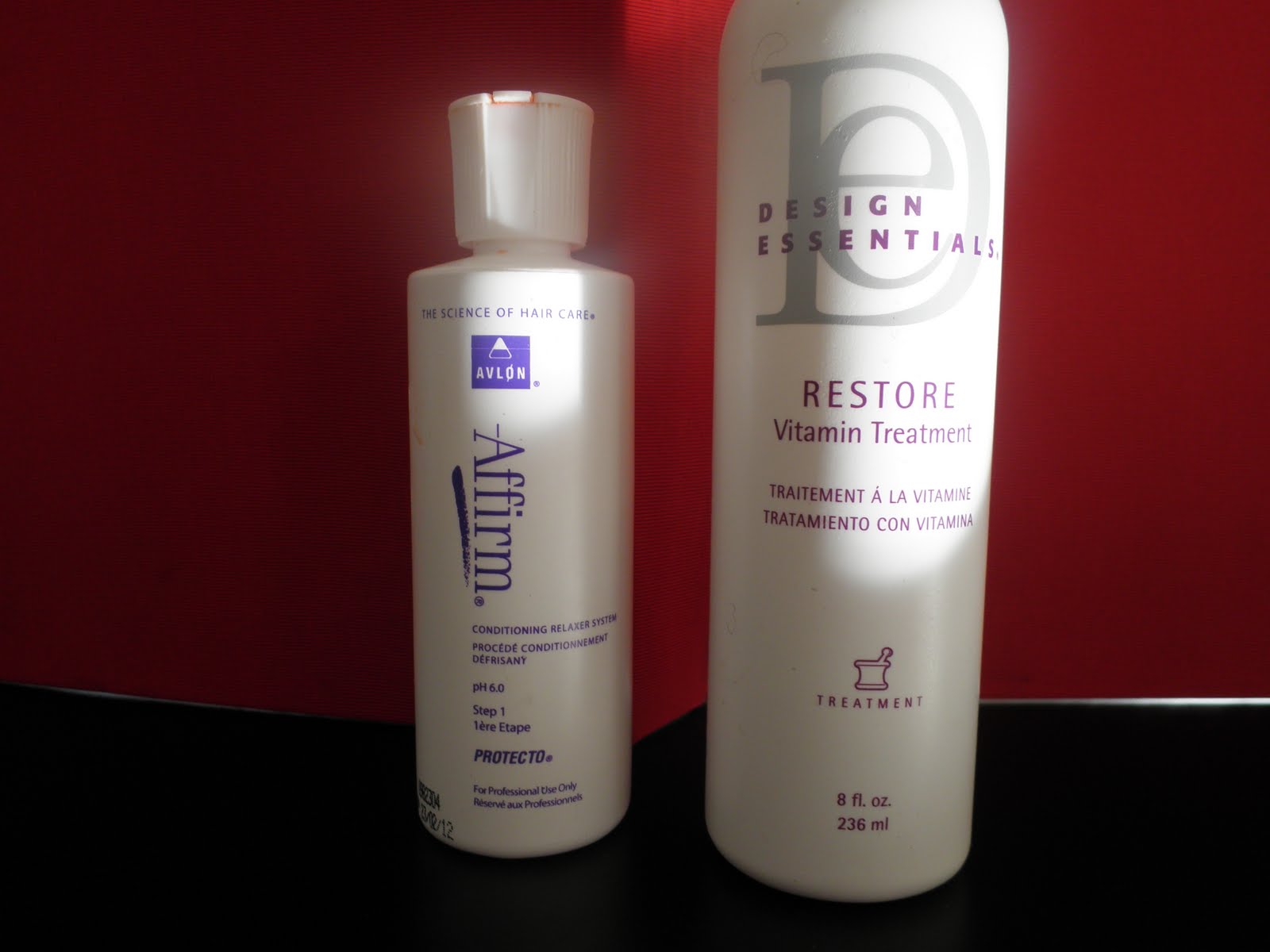
Most Relaxer systems have a "pre-protect" lotion to apply to the previously relaxed ends of the hair strands. Pictured here are the "Protecto" by Affirm and the "Restore" by Design Essentials. Fiberguard Affirm has a "Preservo" pre-protect lotion.

Almost all of the pre-protect lotion/creams are "wet" to the feel. They are designed to fill in the hair shaft, even out porosity, and protect the ends from any relaxer getting in the wrong place. According to the educators in the relaxer classes, this is a necessary step. However, after review of a few youtube videos and playing back in my memory banks a few distinguished classroom settings on relaxer application, I now question if the "pre-protect" step slows the relaxer application time down for some hair types. (i.e. slows the stylist's speed down during the relaxer application step)

Sometimes the hair ends start to stick together after applying the pre-protect lotion. The hair wet by the pre-protect lotion can be harder to part; therefore slowing the stylist application time down/slowing her speed down. However, I know the educators are their to help sell all components of the product line.

According to one youtube video:

http://www.youtube.com/watch?feature=endscreen&v=aCXnMxKNJlY&NR=1
She recommended "two minutes application time" per quadrant. (being four quadrants) The stylist based the scalp, but she did NOT use any pre-protect lotion. The model's hair seemed to be easy to part through. The hair ends did not stick together. I going to assume the model was a type 3 curl pattern. Nonetheless, the relaxer application seemed to be "on point."

I will also say that in part 2 of this particular stylist video instruction which I am not going to attach to this blog, I did NOT agree with blowdry, flat iron, and haircut of the second portion of the video. I felt the blowdry was too aggressive since she was focussed on avoiding uneven processing. I also felt that a roller set would have been more appropriate than flat ironing. This is just my opinion.

Sometimes you have to absorb what you need to know and let the other things that are not applicable to you "go out the other ear."

This article is food for thought. If the client has detangled, manageable hair, then I suggest not to wet it down with "pre-protect" lotion, but DO not be sloppy with your new growth application. This should increase the hairstylist's relaxer application speed. Goal: 2 minutes per quadrant avoiding getting too much product on the scalp.

Also, everyone should keep their ends trimmed to avoid split ends and to avoid the hair ends catching on themselves.

Sunday, December 18, 2011

Six weeks and Five Days Post Relaxer


Judging by my hairline, my new growth at my roots is now officially beyond control. It has been almost seven weeks since my last relaxer touch-up. This is "double" the wait timeframe that I had been performing my touch-ups. Remember I was at about every four weeks? I know. I am always telling my clients that four weeks is too soon. I finally know that I need to listen to my own advice. Smile.

But on a separate note, I met another hairstylist while shopping in one of my favorite stores: Tuesday Morning on last month. I am planning to have her to perform my relaxer touch-up for me this week. With me performing my own relaxers, I really lose control at keeping the relaxer at my new growth/root area. So hopefully, with this hairstylist, I should not get so much relaxer overlap onto my previously relaxed hair.

I plan to have her to use the new formula of the Design Essentials regular relaxer with Shea Butter and Olive Oil. Why? I really think that this particular improved Design Essentials relaxer is a midway point between the Mild True Indulgence (T/I) and the Regular True Indulgence (T/I) relaxer. I believe the Mild T/I relaxer is not strong enough for my type 4c curl pattern, but the Regular T/I relaxer is more aggressive than what I want touching my scalp since I am needing touch-ups within a six weeks period.

I plan to remove my "Holiday Hair" before she performs the relaxer touch-up this week. I will keep you posted on how it goes! Until then, it is "hat time."